Jazz Photographer Lauren Deutsch Captures Aura of Chicago Jazz
By Michael Jackson, Originally posted in Downbeat Magazine on October 19, 2015
Lauren Deutsch, executive director of the Jazz Institute of Chicago (JIC) since 1996, is a focused person. Sometimes sheʼll look past you when you meet her, even if she knows you well, and not quite acknowledge your presence until a little later; she inhabits a certain aura of intensity.
Weʼve shared many a press pit shooting festivals and events, and guys with phallic lenses of impressive dimension will tussle up front elbowing each other to capture the supposed ultimate moment, attempt to freeze-frame musicians performing paradoxically evanescent music. Deutsch often waits, or sheʼs found backstage or to the side of the stage, looking for something different to say about the drama unfolding on the bandstand, with her less hyperbolic equipment (at first a Leica, now a Fuji).
Live music photography is a competitive game, and for the artist more so than the journalist or documentarian, a sense of oneʼs originality amidst the ranks is paramount.
Despite her day gig, raising money to perpetuate and proselytize the merits of jazz, trying to appease and appeal to all strata of that community—the Latin faction; the straightaheaders; the up-and-comers who need to discover jazz instead of less salutary pursuits after school; the free-form and AACM crusaders—Deutsch has needed to find a deeper place, a richer contribution, if one were possible, to jazz—an artform she loves.
As evidenced by Lauren Deutsch: A Musical Metamorphosis, Photographs from 1979–2015, a retrospective at the University of Chicagoʼs Logan Center that ran Sept. 16–Oct. 18, she has evocatively transliterated the act of improvising music to an impressive visual dimension.
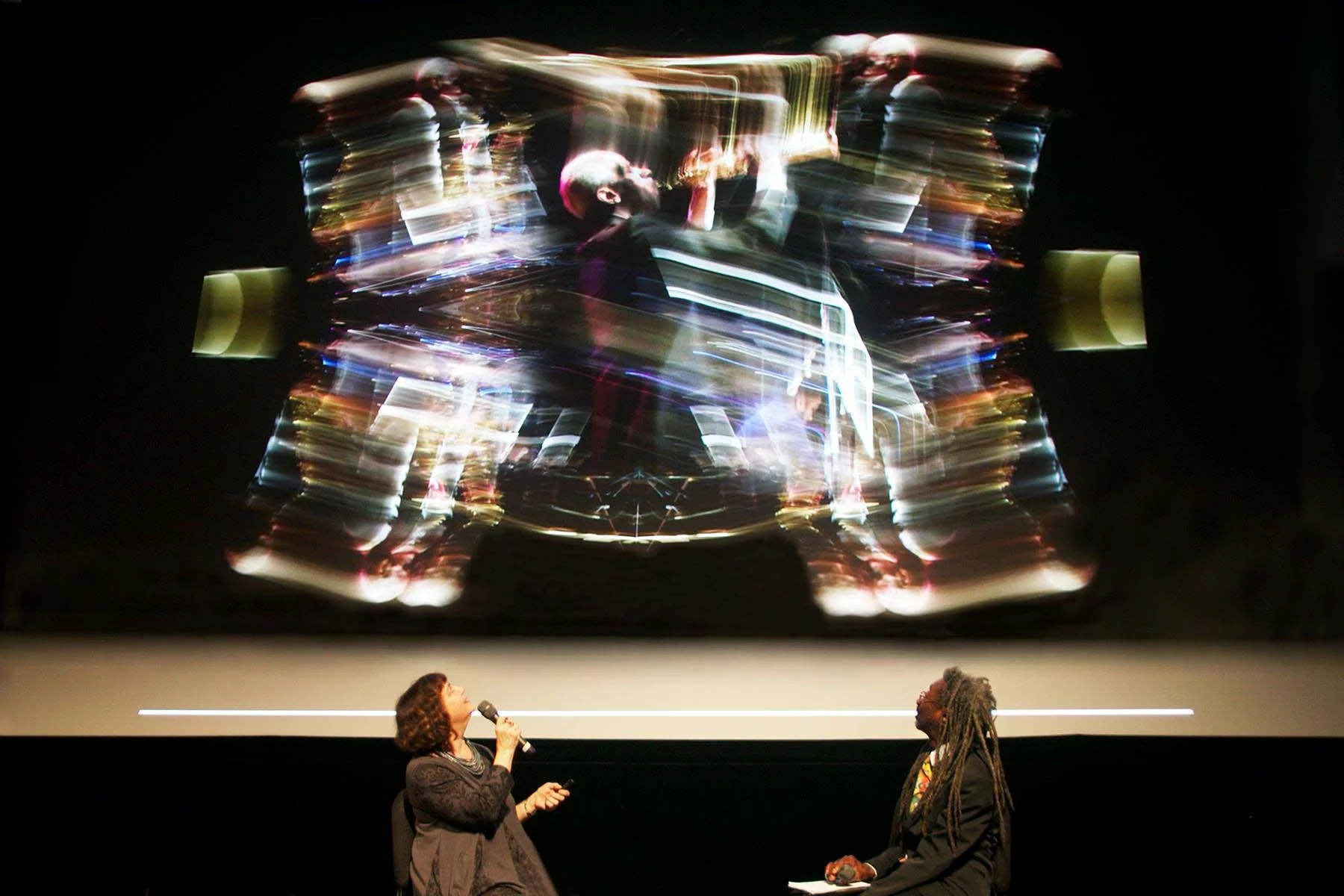
In discussion with pianist/composer Robert Irving III during the Hyde Park Jazz Festival, Deutsch showed slides of her favorite images in the Logan Screening Room under the heading Tangible Sound: 35 years of Photographing the AACM.
The first images she showed were vintage black-and-white prints of such subjects as saxophonist Fred Anderson and bassist Malachi Favors, depicted in dingy, long-forgotten loft spaces in the late ’70s and ’80s. The challenge to capture sharp shots of performers in action without the disruptive use of flash in the days of celluloid were considerable, and since Deutsch would print in her home darkroom, black-and-white photography was more practical than color.
One of the more puzzling pieces in the exhibition was constructed of strips of torn film depicting sound/light waves, collaged together to suggest a dark, dimensional space from which sonic impulses emerge. In the context of the rest of her oeuvre, it seemed anomalous, as it contained no human subjects or instruments but is actually prescient of the technique she would explore when she finally made the leap to digital photography in 2001.
Deutsch was disarmingly modest during her conversation with Irving. Though she alleged it was one of the first occasions she had been invited to talk about her work, she was eloquent and poetic without pretension. She recalled how she began to discover with digital photography the magic of extended exposures, which allowed patterns and trails of light to form at the expense of specific focus. This was possible with traditional photography, but not instantly viewable. Digital now allowed for adjustments in the field.
Deutsch described how she became attracted to certain favorite subjects among the membership of Chicago’s innovative and colorful Association for the Advancement of Creative Musicians, including Nicole Mitchell, Mwata Bowden, Roscoe Mitchell, Tomeka Reid and Edward Wilkerson. The latter is featured in a spectacular image where trails of light follow Wilkersonʼs form as if painted with a wide, coarse brush.
Deutsch became acquainted with what she dubs “the light signature” of certain musicians, based on the shine emanating from their instrument, be it tenor saxophone, cello or French horn. She would adjust her body movements to suit, making sweeping gestures with her camera in tandem with the music, to extend the light trails into dramatic shapes that attempt to illustrate notes or soundwaves.
It’s a hit-and-miss procedure, and early on, when she discovered by accident the potential for slow shutter-speed light effects, she was counseled by Wojciech Juszczak, a culture manager at Estrada Poznanska in Poznan, Poland (where Deutsch is involved with a Chicago-centric jazz festival each November), who became her chief supporter. Juszczak (who passed, aged 49, in 2013) stated, “You must control the technology—don’t let the technology control you,” as a warning to Deutsch to bring her process somewhat to heel.
At this point in Deutschʼs reflections (her exhibition is dedicated to Juszczak), Irving commented that during his tenure with Miles Davis, the trumpeter—who, like Irving himself, was also a visual artist—advised him, “Don’t play a note unless you really feel it.”
This parallel wasn’t perfect. To arrive at satisfying images, given the element of chance procedure due to the play of available light in a given venue, Deutsch is forced to make multiple sample shots. But Irving had interesting points to make about music making vis-à-vis photography. As Harlem photographer Roy DeCarava (surely an influence in early Deutsch) once enigmatically said about the relationship between photography and jazz, “In between that one-fifteenth of a second, there is a thickness to it.” Although Deutschʼs current shutter speeds are doubtless even lengthier than those of low-light specialist DeCarava.
The most recent work in the lifelong Chicagoan’s prolific output has become much more accomplished in tracing those light signatures and “palettes of sound,” as Deutsch puts it, with full spontaneity, where earlier prototypes reveal how she combined layers on Photoshop, created Rorschach/mandala-styled double images and used collaging and mosaic techniques to arrive at successful compositions.
Photographer Henri Cartier-Bresson, who espoused fleeting movement in images and what he coined “the decisive moment,” decried the necessity for focus as a “bourgeois” proposition, yet it’s been the focused determination of Deutsch to pursue an alternative approach that has resulted in her images becoming as readily identifiable as the saxophone sound of Roscoe Mitchell or the trumpet of Lester Bowie.
The experimental bent of the arts in Poland—the radical poster designs that incorporate Deutschʼs imagery for successive Poznan Jazz Festivals were displayed at the Logan—clearly further inspired Deutsch, pushing her to feature expressionistic photo portraits on many flyers and postcards for JIC events or calendars for Fred Andersonʼs Velvet Lounge in Chicago.
She also credited the encouragement of such artists as Nicole Mitchell, Bowden and Roscoe Mitchell, who suggested the pertinence of her electrified images to their musical mindset, solidifying the connection between the unique music of the AACM and Deutschʼs own aesthetic.
Another abettor who shouldn’t be neglected (beyond Lauren’s daughter Zoe Netter, who was of enormous help selecting the works) is Logan Center director Bill Michel. By inviting this retrospective show Michel immediately spring-loaded future leaps in the work.
What most impressed, however, was how an innovative and committed body of work continues to emerge from someone who still appreciates the wonder and communal discovery of the process, without cynicism and complacency. Thus, there seems much more in store from Deutschʼs sonically infused art.
—Michael Jackson